What’s the first thing you do when you connect to the internet? If you’re like me, you’ll go to Google.com. Each browser comes with a default search engine, and for most of us, it’s Google. That gateway earlier had two main buttons: Google Search and I’m Feeling Lucky. I’m Feeling Lucky simply opened the first link that Google ranked the highest for the query.
In 2022, ChatGPT was released by OpenAI, and it was a game-changer. It was able to answer questions better than any other search engine, although it didn't have the ability to be up-to-date with the latest information. It was able to write code and even write essays. As the traffic on ChatGPT grew, Google had to act fast before it lost its own game. After many iterations, like LaMDA, PaLM, Gemini Studio, NotebookLM, etc., a new AI Mode was unveiled in March 2025 in the U.S. They took a lot more time to bring this to the forefront compared to other AI companies, even though the seminal paper on transformers was published by Google researchers. This was mostly because they couldn't risk their reputation with a "half-baked product" and, practically, AI-based search breaks the main business model of Google's Adsense.
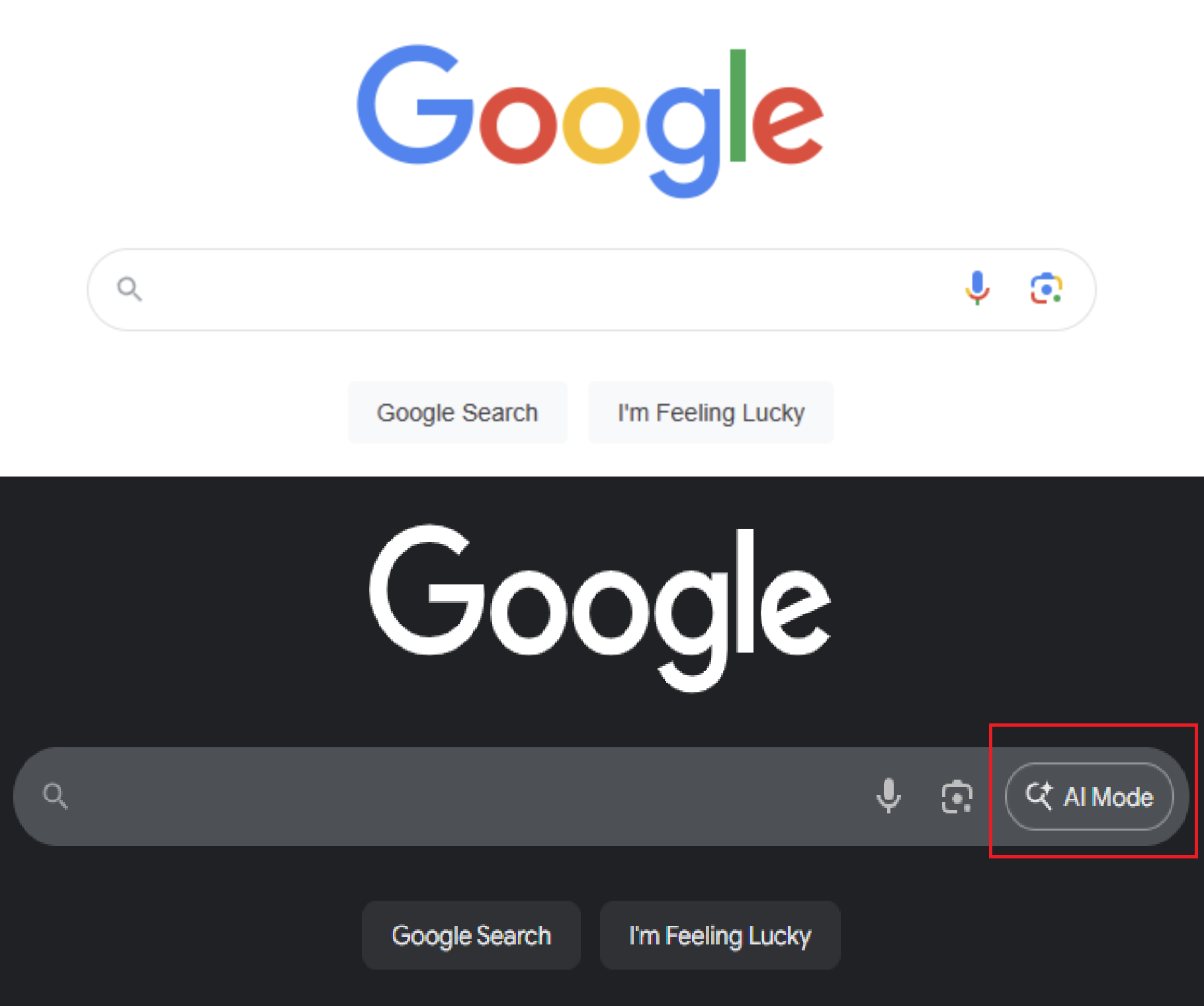
And just like that, the gateway to the internet (and practically the internet itself) has changed forever.
As I work in the industry related to AI and its applications, I've been thinking a lot about the future of AI and the internet. I've been thinking about the impact of AI on society, the economy, the job market, the environment, privacy, the human mind, how it changes creativity itself, and more. In this post, I’ll be discussing what I think AI is, the affordability of AI, some of its dark sides, and finally some of my own "predictions" for the future of AI and the internet.
Artificial Intelligence is a Tool
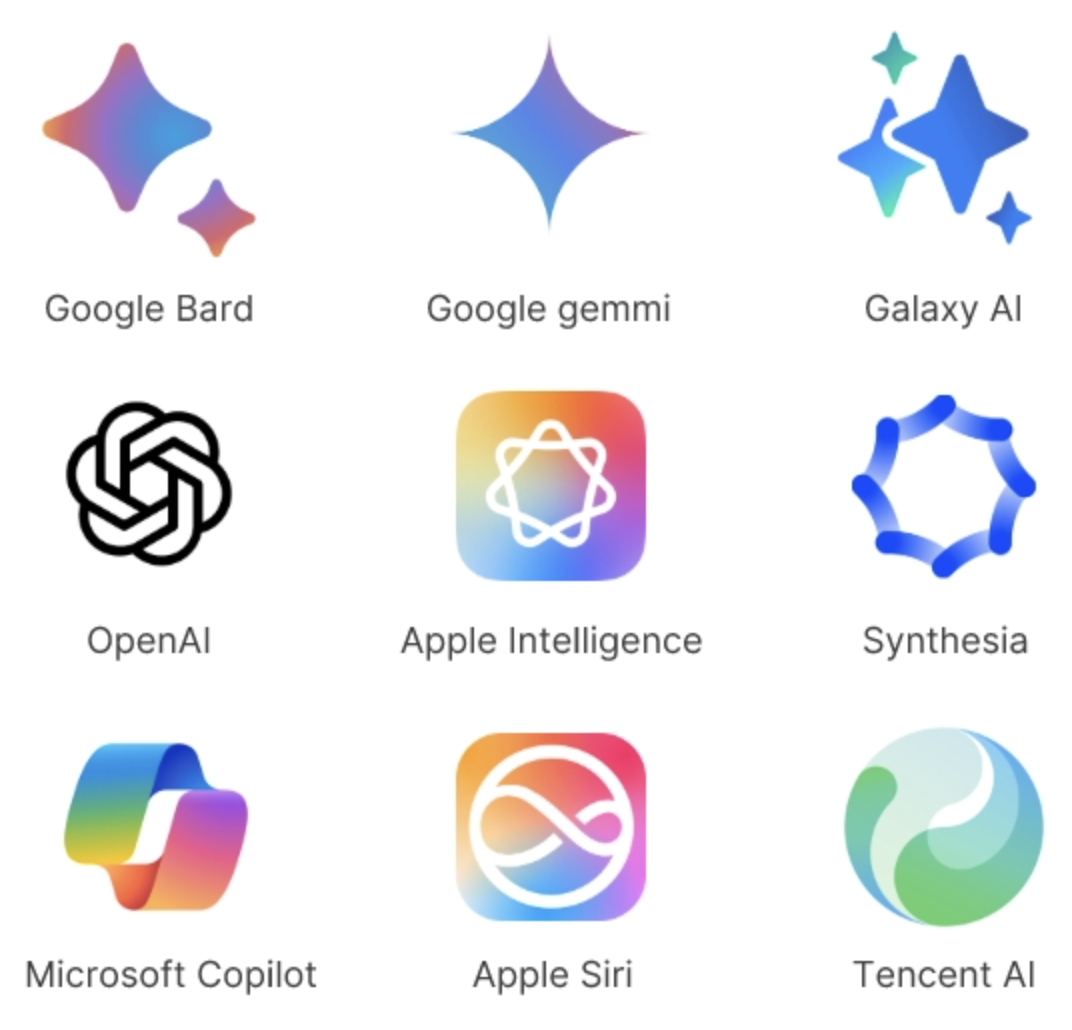
Like most human inventions, AI is a tool. It's multi-disciplinary knowledge put into an application to make almost all human knowledge available to you instantly via a digital interface. It's the evolution of the written word and the internet. I understand it feels like a magical tool. See all the different logos from various companies—they all look like a digital, all-encompassing oracle. These companies might want you to think it can never be wrong, that it can do anything, that it’s the ultimate future. But it’s not. It’s limited by the knowledge it's trained on, which is not even close to the entire human knowledge; the modalities it can work with (can it smell? feel? taste?); and the computational power and time it’s provided to solve a query. Even if we assume it has all the human knowledge in the world, human knowledge itself is not complete or even "perfect"; there can be more than one truth sometimes (or most of the time).
Because it’s a tool, we should be aware of both its use and abuse. Given its immense potential to help you solve problems faster, not using it would surely leave you behind in the race you’re running, whatever that race is. If you’re into making films, writing novels, producing music, working on electronics, or farming, etc., you should figure out the tool that integrates AI into your workflow and learn to use it. Don't blindly follow it; understand its capabilities and its shortcomings.
Is it affordable for all?
Future is now and here, but, it's unevenly distributed
Access to technology is not the same for everyone. In general, access boils down to "availability" and "affordability." There are different aspects that govern availability, which we'll skip for the time being. But, talking about affordability, we can get a sense of the problem of access to these tools with some income-based data available about the world.
As of this writing, the latest and greatest models from big-technology companies cost in the range of approximately $20 per month per user, and these are still rate-limited. How many people do you think can afford that? The lower-end of the best AI model devices cost more than $350, and then there's the application fees. Each "good" AI application (for example: Cursor AI) you want to use might have its own cost, potentially bringing the total cost to a multiple of the base price. The free tier is generally highly rate-limited or has many other restrictions, such that to effectively use the tool, you need at least the first paid subscription.
Let’s say the AI usage cost for an application-heavy user is , where is the cost of the base LLM you generally want to use, is the number of applications you use, and is the average cost of each AI application you purchase. Assuming a base LLM cost of $20 and $20 for each application as well; for a light user (1 to 2 applications, i.e., 1.5 average), for a medium user (2 to 3 applications, i.e., 2.5 average), and for a heavy user (5 to 10 applications, i.e., 7.5 average), the cost of using AI in your daily "productivity" life would range from $50 to $170 per month. Also, once you become a heavy user, your base LLM cost can rise much above $200, totaling the cost upwards of $400–$500 per month. To put this number into perspective, that currently is like buying 4 to 6 iPhones in a year. 😱
Looking at the income groups of the world in the infographic above from "Our World in Data" shows that most of the world's population can't afford these tools if they also want to afford basic housing, utilities, food, etc. This brings back the need for small LLMs that run on the edge and the hope that this affordability gap continues to reduce. The cost keeps coming down for access to this technology in some form or another. This is a magical tool, and hopefully, the power of intelligence is in the hands of everyone so that they can make better decisions, help with whatever they're doing, and certainly uplift society to the next level. "Intelligence on demand"—it's the evolution of computing and the integration of computing with human action and perception.
Access is definitely democratized via the Hugging Face ecosystem of models. But you need expertise in using those models, plus a GPU or at least a decent laptop. They'll never be as powerful as what you see in the applications created by BigTech. Locally, most models won't have the right scaffolding and machinery required to give a "good" answer and will generally run with reduced thinking due to local inference limitations. BigTech has the ability to run the larger models with more efficiency, at-scale, and has the expertise to keep these models up-to-date with the latest information. I think that's why almost all governments are trying to achieve AI sovereignty: data-pipelines custom-built for the country with the ability to satisfy the intelligence demands of the population.
The dark side 🌗
I think with anything great, come its dark sides. Nuclear technology, deemed to be the best energy source, has also led to nuclear bombs and some of the worst mishaps in human history. The same is true with AI. The LLM we all love and adore also has childhood issues.

- Errors, compounding errors: LLM errors compound with each token. Once the model is on the wrong path of token generation, everything downstream will also be bad. Look at examples of slop.
- Energy requirements: As these models run on highly-specialized chips that are hungry for power, running world-population-scale intelligence on demand requires an immense amount of electricity.
- Increased inequality: Technology is an enabler. Let’s say you get a car—you can travel further and get anywhere faster. The same applies to human cognition. These tools will help you reach your mental-goal faster. This gives you an edge over someone who's simply walking towards that goal.
- It's a crutch: Using a car to get everywhere can make you lethargic and unable to walk when needed. Similarly, always relying on AI (your brain-car) can cause your brain to atrophy.
- Mass surveillance:As this tool helps "read" any digital information, it also opens the gate for mass surveillance, which is already happening around the world.
- Eroding Trust: The internet is filled with bots and deepfake content. Even customer service is just filled with bots. Your email is filled with auto-generated emails. It's easier for anyone to scam you with deepfake voice/video. When everything you see, you have to see with a suspicious eye, it indicates an erosion of trust. In 2024, bots comprise more than 50% of the internet traffic. The thing you did is probably now only consumed by another algorithm.
Is AGI real or that mythical land of abundance?
These are some raw thoughts for you! Any chatter about AGI (Artificial General Intelligence) is purely philosophical at this point. Most experts disagree on the timeline for when we’ll achieve AGI.
Isn't the dream of AGI similar to the dream of time travel? As soon as computational methods reach a certain AI goal, we just move the goalpost further and then solve those goalposts again. I think as humans, we always look for that infinite resource or a perpetual machine, per se—something (AGI) that will solve all our problems. And I think AGI is contextually marketed in the same format by BigTech. Artificial intelligence is quite different from the intelligence humans possess. One is designed to mimic the other through a digital interface, but there are subtle but crucial differences. Although, I'm not sure if we have any new Turing tests or if those "Are you human?" tests still work on the internet, because you are seeing a human through their digital image.
I have a theory: will AGI be more like a god than a human for everyone? Will there be many AIs or just one? If you have played board games like "raja mantri chor sipahi", Mafia, or Werewolves, you would know what I mean by "god" here—the one that writes the rules or upholds them. Algorithms that run your life 24/7. You're being interviewed by an AI. Your meeting notes are coming from another AI assistant. Your research is being done with an AI assistant. What you watch on the media is being run by an AI. Your healthcare claim will be accepted or denied by an AI. Who you make friends with is decided by an AI. Your next date is decided by an AI.
The philosophy of AGI blends into Gödel's incompleteness theorem, and I think the existence of AGI contradicts some fundamental laws—not sure which ones. But there definitely can be an intelligence that runs your life; it doesn't need to be an AGI 😊.
Predictions for the next 5-10 years
To finish off the blog, I wanted to think hard about some of the highly likely things to happen. I am not the best expert, so take my predictions with a grain of salt. But you're reading my blog, so you might as well finish this last part.
- The error rate of AI systems will remain, but we’ll build reliable engineered systems on top of them to make them generally useful across many industries. It will bleed into Agentic AI, that is, AI working autonomously without any human intervention.
- AI platform companies will solve commerce and ads on AI, such that the economy can be powered by these systems. Companies will fight to be the brand recommended by your AI.
- In most cases, purpose-built foundational models of many different flavors will exist for each industry and problem type. AI will be a hybrid of Small and Large models, deployed locally and through the cloud, respectively.
- No, you’re not going to lose your job to AI anytime soon. But, you will lose your job to someone who knows more about AI than you—how to use it. Maybe more people will go into entrepreneurship, as AI democratizes knowledge.
- Only bots will visit your website. When trust in AI builds up, people will stop looking at the citation and directly ingest the AI's output without question. I don't know how much frameworks like RSL will work in the long term.
- We won’t achieve AGI, but we will continue to solve harder and harder problems with the help of AI. We just have to keep asking the right question (🤧 prompt).
If you’re really curious about this stuff, go on and read: https://ai-2027.com/research. They have some wild predictions.
Blog Updates
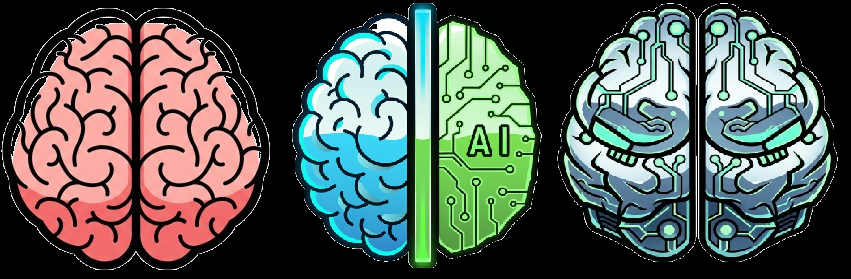
In the spirit of this blog, I'm adding a small icon to differentiate between different articles on my website:
- Brain Logo 1: Have they been entirely written by me
- Brain Logo 2: with the help of AI
- Brain Logo 3: fully automated.
I think most articles will be me+AI (except for this one), as I have no intention of going back to writing everything on my own in this world of hyper-speed. This is a magical tool, and I want to learn how to best use it. The only way to do so is to use it often.